Crews cut the fuel and the wood stays.
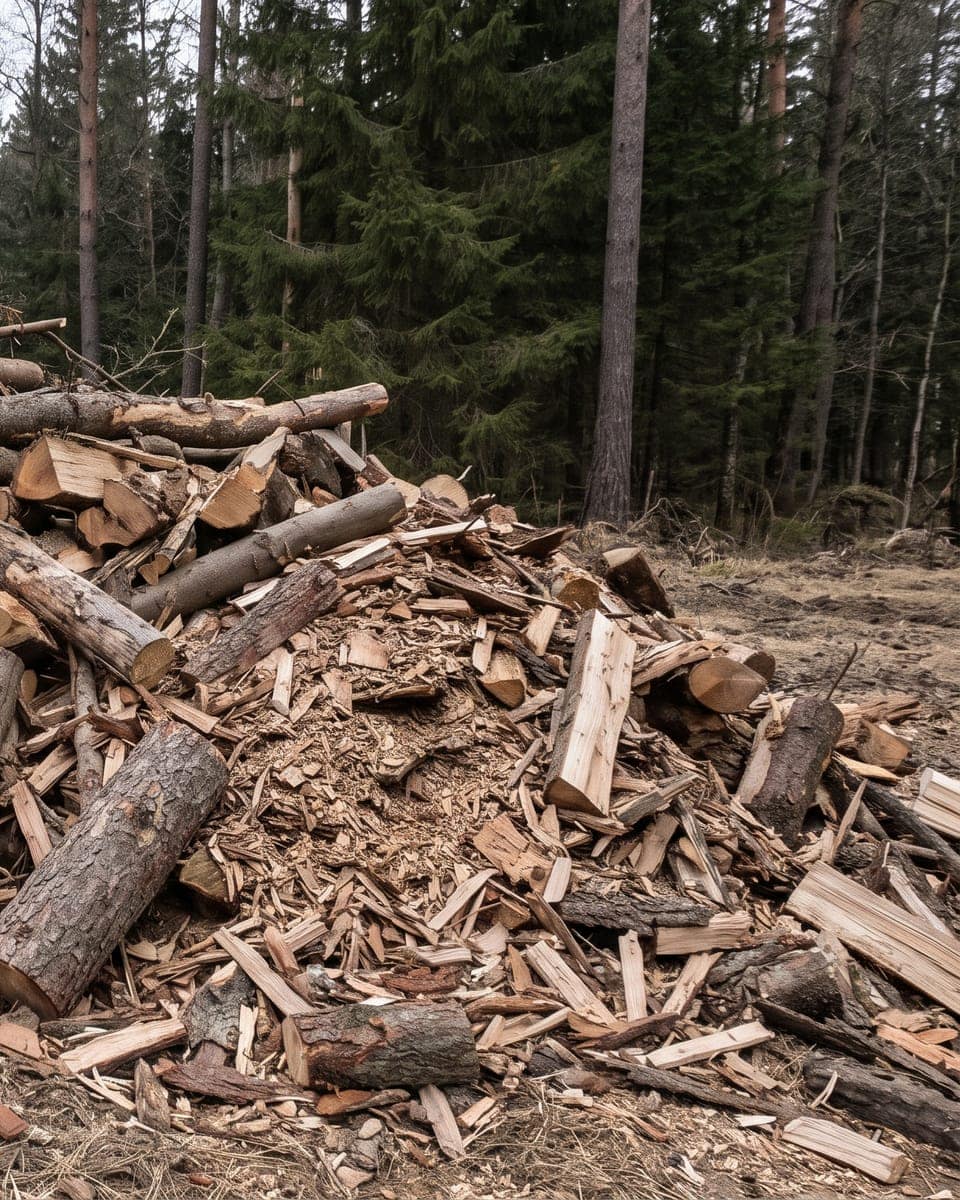
Vegetation management produces woody residuals that can persist in dry landscapes. Hauling, burning, spreading, and processing each carry cost, logistical limits, and ecological consequences.
Biogeotechnics builds fungal systems for burned ground and for the woody material that fuel work leaves behind. We are in development in California.
Scientific development Validation phase California
Two bounded problems sit on either side of a burn. Biogeotechnics is developing separate fungal treatment protocols for both.


Vegetation management produces woody residuals that can persist in dry landscapes. Hauling, burning, spreading, and processing each carry cost, logistical limits, and ecological consequences.
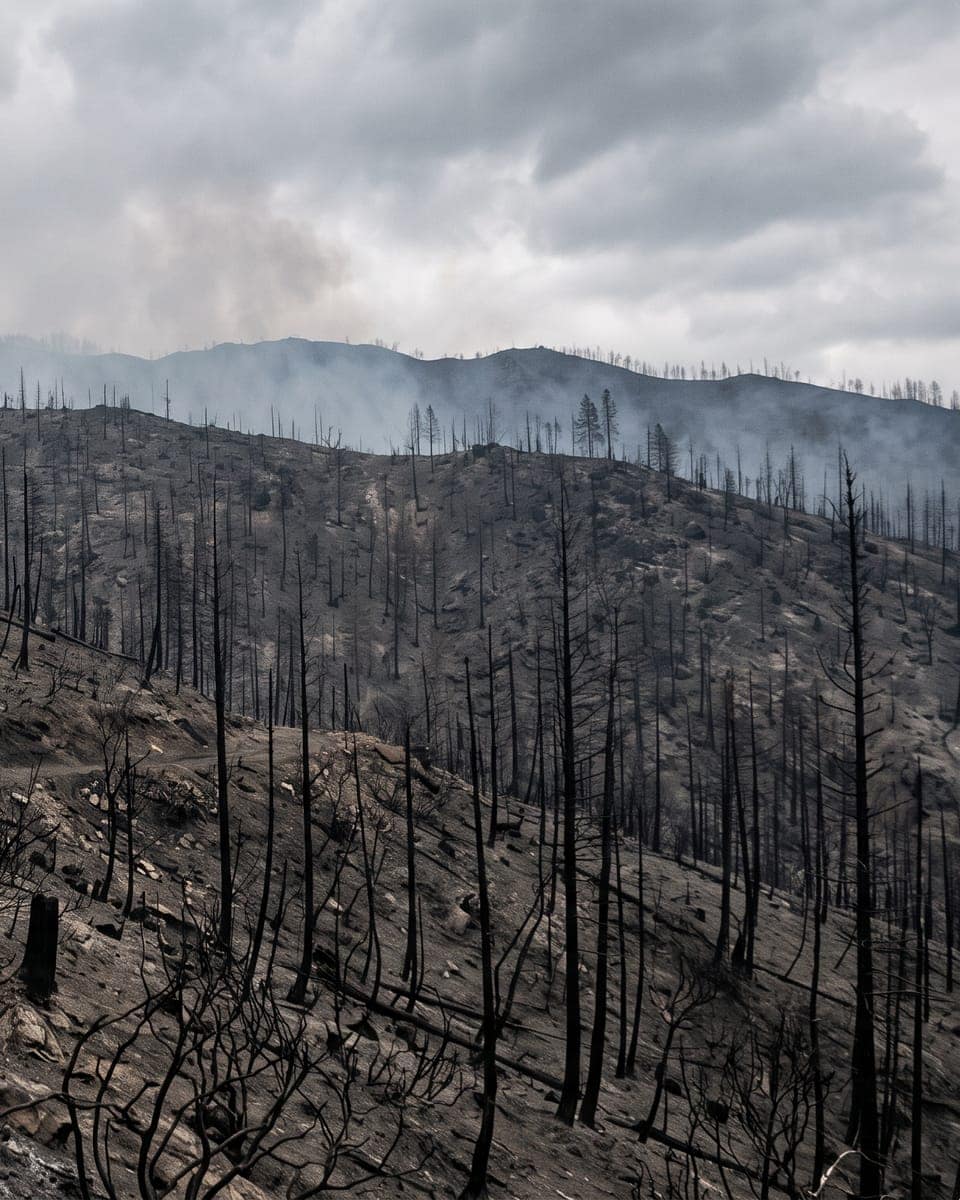
Fire removes the vegetation holding a slope together and changes the soil itself. The surface left behind sheds water instead of absorbing it.
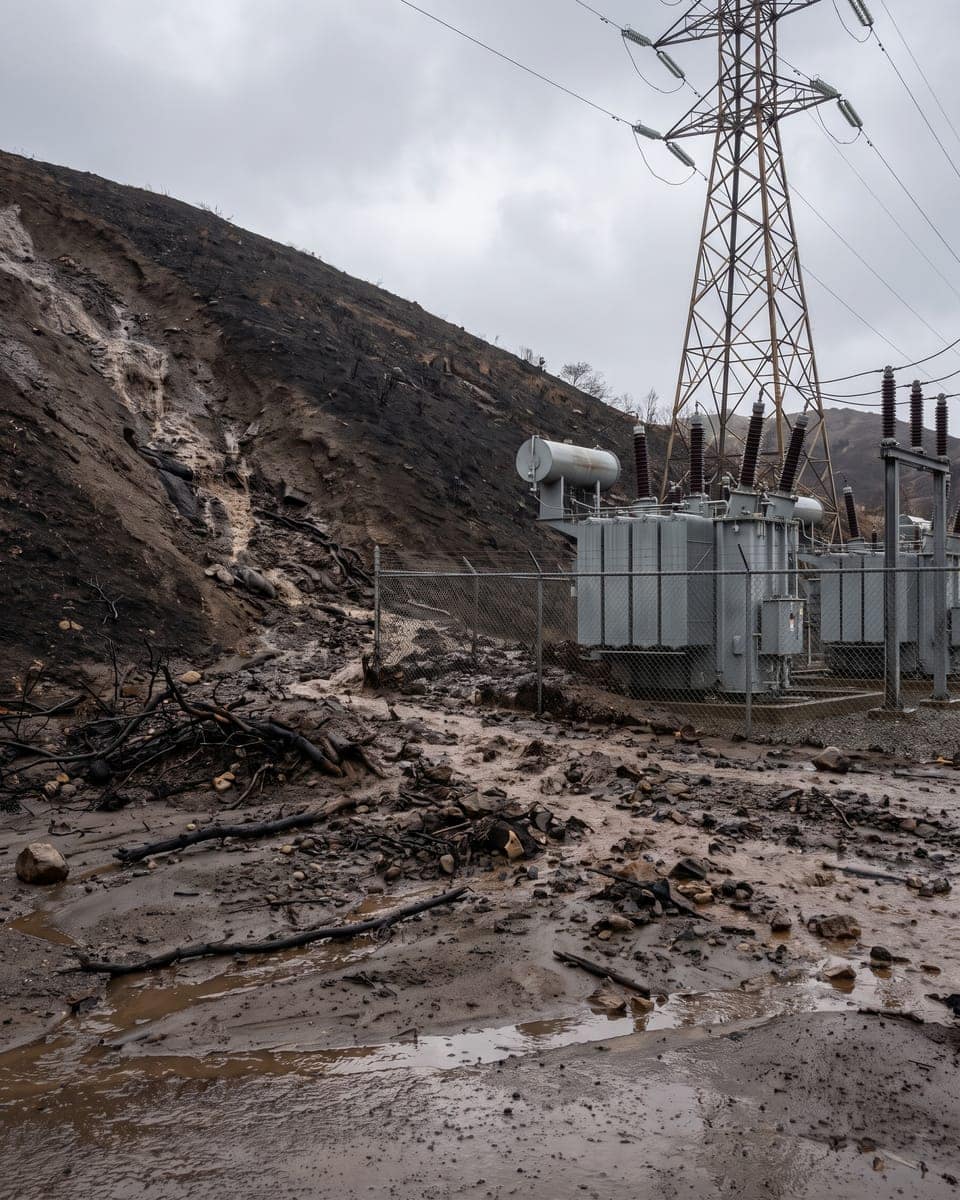
Heavy rain on a burned slope drives erosion, runoff, sediment movement, and debris flow. Those conditions can threaten substations, transformers, transmission corridors, access roads, watersheds, and the communities downstream.
Fungi break down wood. We grow those fungi in liquid, apply them where we choose, and measure what changes.
Clearing vegetation to reduce fire risk leaves piles of woody material. It rots slowly and costs money to haul, so it stacks up.
Technical Fuel-reduction and vegetation-management work generates woody residuals with high lignocellulose content and long field persistence.
Some fungi break down the tough material that makes up wood. We grow them in liquid, which lets us produce them in batches and carry them into the field.
Technical Wood-decay fungi carry the enzymatic machinery to dismantle lignin and cellulose. Liquid-culture production makes that biology batchable and deployable.
After a fire, rain moves bare soil downhill as erosion, mud, and debris. We are testing whether fungal networks help hold that soil in place.
Technical Hyphal networks enmesh soil particles into aggregates. Aggregate structure governs infiltration versus overland flow on burned slopes.
These mechanisms come from general mycology, not from Biogeotechnics results.
Active large wildfires across the United States, drawn from the National Interagency Fire Center each time this page loads.
The two protocols share a production system and diverge at the point of application. They are developed, produced, and evaluated separately.
Liquid fungal treatments for woody material created by fuel-reduction and vegetation-management work, developed to accelerate biological processing and reduce the persistence of residual biomass.
Liquid fungal treatments for burned ground and defined carriers, developed to hold soil, slow sediment and runoff under heavy rain, and support recovery at bounded sites.
Each system combines culture selection, controlled production, application design, trained field deployment, and monitoring.
Selecting and authenticating fungal cultures for the target material and site.
Read the step → 02Liquid-culture production under documented quality controls, batch tracking, and release criteria.
Read the step → 03Site-specific application and carrier design matched to terrain and hazard.
Read the step → 04Installation by trained field crews within defined weather and safety windows.
Read the step → 05Baseline and post-installation monitoring against a defined control.
Read the step →Both protocols depend on how a fungal network grows. Move your cursor across the culture to grow it.
A fungal mycelium is a branching network of hyphae that grows through soil and dead plant material, following gradients of moisture and food.
Lignin and cellulose are the structural polymers that make woody material slow to disappear. Wood-decay fungi are among the few organisms with the enzymatic machinery to dismantle them.
Fungal networks enmesh soil particles and organic matter, and contribute compounds that hold those aggregates together. Aggregate structure governs how much rain enters a slope and how much runs across it.
Growing the culture in liquid gives us defined batches and something a field crew can carry and apply across terrain.
General mycology, included to explain what the platform is built around. Not Biogeotechnics results.
Two founders: one who has grown fungal cultures and run field deployments, one who leads venture development.
Galen Scott founded Biogeotechnics to take fungal cultivation and field practice into environmental work. At Boulder Mushroom in 2024, he produced fungal inoculum and liquid cultures, deployed liquid slurry and colonized substrates, and contributed to four publicly documented Colorado project contexts.
Project leadership set the treatment areas and objectives; Scott turned them into field plans. He sequenced treatments with the deployment crews and assigned roles on site. He leads the same three areas at Biogeotechnics: cultivation, soil ecology, and the work that happens on the ground.
Gianluca Hildebrandt studies Entrepreneurship and Global Business at the University of Miami Business School. At Biogeotechnics he leads venture development: the work of moving a development-stage platform toward its first pilots. He covers financial strategy, partnerships with the agencies, utilities, land managers and delivery partners the two programs need, and the planning that has to happen before a crew goes out.
Four publicly documented project contexts from Galen Scott’s 2024 work at Boulder Mushroom. Each links to its public record.
A scale-up of fungal treatment of wildfire-mitigation wood chips with native mycelium, developed to accelerate decomposition and reduce residual fuel on the landscape.
Galen Scott’s role: produced inoculum and deployed liquid slurry and colonized substrate in the associated field work. Boulder County record →Boulder Mushroom worked with Boulder Watershed Collective and Grama Grass & Livestock to move forest-management biomass into fungal processing for use on degraded agricultural land, with public support from Boulder County and the City of Boulder.
Galen Scott’s role: participated in laboratory and field deployments, including production and placement of colonized material. Boulder County record →A 2024 collaboration with Boulder Watershed Collective, Mad Agriculture, and Good People Tree Service using Front Range fire-mitigation wood chips for soil regeneration in Boulder County.
Galen Scott’s role: participated in the fungal-treatment field deployments. Good People Tree Service →Fungal treatment of broadcast wildfire-mitigation wood chips documented in the Gold Hill area of Boulder County.
Galen Scott’s role: performed a field deployment in the Gold Hill project context during 2024. Colorado Sun report →Biogeotechnics is an independent company and is not affiliated with or endorsed by Boulder Mushroom or the organizations involved in those prior projects. These projects are presented as Galen Scott’s prior field experience, not as Biogeotechnics deployments, partnerships, sponsorships, or performance results.
Biogeotechnics has secured a warehouse in South San Francisco, California, for its first laboratory and liquid-culture production facility.
The site provides water, drainage, ventilation, three-phase power, and space for laboratory production and field staging.
The facility is being prepared for formal buildout following seed financing.
Biogeotechnics is developing its first California pilot pathway for burned slopes and drainage paths where rain-driven erosion, sediment, runoff, or debris movement threatens critical infrastructure or downstream landscapes.
The initial target geography is Malibu and western Los Angeles County.
Exact site selection, professional review, permitting, treatment design, and monitoring will be completed with the appropriate landowner and delivery partners.
A sequence with no dates attached. We have finished nothing past the stage marked in progress.
Selecting and authenticating fungal cultures, and developing the two field protocols and their application design.
In progressThe South San Francisco warehouse is secured for buildout. It is being prepared for formal buildout following seed financing. It is not operating.
Secured, not builtDeveloping a pilot pathway in the Malibu and western Los Angeles County target region. No site, landowner, permit, or delivery partner is secured.
Pathway in developmentBaseline and post-installation monitoring against a defined control. No treatment performance has been established.
Not yet begunSwipe the stages, or tap a stage above.
Public data feeds and teaching tools. Third-party sources, not Biogeotechnics monitoring.
A pilot needs a site, an owner, and a permit. These groups control them.
Substations, transformers, transmission corridors, and access roads sit below slopes that move after a burn.
Discuss a pilot →Fuel-reduction work produces woody residuals that have to go somewhere. That is the pre-fire protocol's target.
Discuss a site →Municipal, county, state, and federal bodies carrying post-fire recovery and watershed responsibility.
Start a conversation →Watershed and land-management groups working on burned ground and downstream sediment.
Partner with us →Universities and independent laboratories. Independent validation is step four of our own sequence.
Discuss validation →The facility is secured for buildout and awaiting seed financing. The development path above says what is done and what is not.
Read the development path →